

Intro
Easter is now over. And with that the next major Christian holiday is Pentecost Sunday. Pentecost Sunday occurs 7 weeks after Easter. And while I probably don’t have to tell you what occurred on that day in Christian history (though if you are new to the faith I will be sure to explain it for you), I’m willing to bet you aren’t fully aware of the Old Testament origins of Pentecost as a Jewish harvest festival. And if you want to be technical, part of what we as Christians recognize as happening on Pentecost is a harvest of sorts. Just not in the agricultural sense.
Shavuot
You might be thinking, “What did I just read?”, “What is Shavuot?”. Shavuot is the Hebrew word for the festival that occurs on the day we call “Pentecost”. It is Biblically called the Feast of Weeks. In terms of timing, the Israelites celebrated Passover, counted 49 days – or 7 weeks, hence the name – and then on the 50th day, celebrated this feast (see Leviticus 23:15-16 and Deuteronomy 16:9-10). Because it occurs on the 50th day after Passover, it also got the Greek name, Pentecost (which means “fiftieth”) – as we see in Acts 2:1.
Shavuot is an agricultural festival related to the first fruits of the wheat harvest happening at this time of year. Consequently, part of the offerings brought to God included two loaves of bread baked with the first fruits of the harvest. In addition, they offered a bull, rams, lambs, a goat for a sin offering and more lambs for a peace offering (Leviticus 23:17-19). It was also one of the festivals that required mass pilgrimage to Jerusalem. So the city would be packed year after year on this day.
As tends to happen, Shavuot also became associated with something else important from Jewish history. The giving of the law. Some Jewish traditions hold that 50 days after the first Passover in Egypt, the Israelites arrived at Mt. Sinai. And in fact, the Bible does say “in the third month” after leaving Egypt they arrived at Mt. Sinai. And 50 days after Passover – middle of the first month – would have been “in the third month” (third month of the Jewish year, not third month after leaving Egypt, just to be clear). Whether that’s true or not, Pentecost became a holiday not only for the wheat harvest, but also to remember the giving of the law at Mt. Sinai.
Bonus: The Jubilee Year Connection
One quick note, is that Pentecost and the Jewish year of Jubilee both had the number 50 attached to them. Pentecost was celebrated 50 days after Passover and every 50th year was the year of Jubilee. During this year, debts were cancelled, enslaved Israelites were set free, and the land was not worked. No sowing, plowing, reaping, etc. Consequently, the number 50 itself had connotations with freedom and rest.
And as you’ll see later, all these things I mention here become reflected on the day God poured out Holy Spirit on the disciples.
Pentecost of Fire
Jumping ahead to the New Testament, 50 days after the Passover at which Jesus was crucified, all the disciples (120 in all) were in an upper room praying. And they were expectant. How do I know they were expectant? Take a look at what Jesus said before He ascended.
On one occasion, while he was eating with them, he gave them this command: “Do not leave Jerusalem, but wait for the gift my Father promised, which you have heard me speak about. For John baptized with water, but in a few days you will be baptized with the Holy Spirit.”
Acts 1:4-5 (NIV – italics added)
At this time, it was probably around 9 days since Jesus said these words to them. Perhaps less. So they were all eagerly awaiting this promised gift of Holy Spirit to be poured out upon them. They were probably planning on taking advantage of all the pilgrims who were in Jerusalem for Pentecost and witnessing – seems logical. Then God did something amazing. Take a look at what Luke writes in Acts 2.
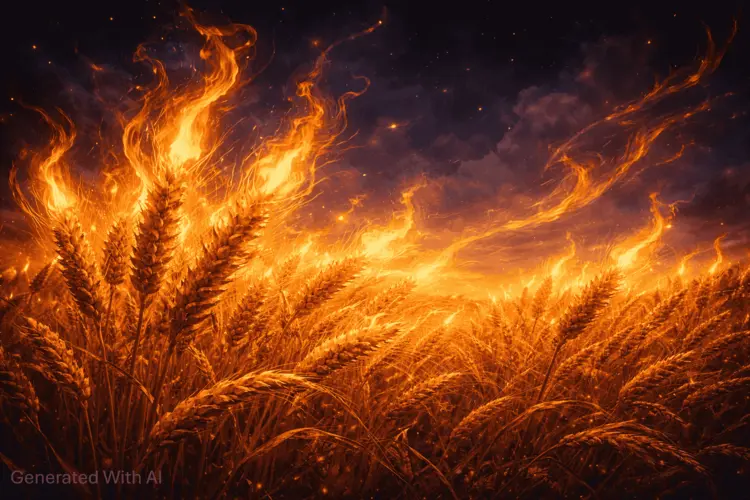
When the day of Pentecost came, they were all together in one place. Suddenly a sound like the blowing of a violent wind came from heaven and filled the whole house where they were sitting. They saw what seemed to be tongues of fire that separated and came to rest on each of them. All of them were filled with the Holy Spirit and began to speak in other tongues as the Spirit enabled them.
Acts 2:1-4 (NIV)
The very thing they’d been waiting for that Jesus told them would come finally came! Filled with Holy Spirit they preached (in all the languages represented by all the pilgrims) to all who would listen and 3,000 people got saved that day.
This is the Pentecost that Christians remember and celebrate. But what’s interesting are all the little connections between Pentecost the harvest festival and Pentecost the day Holy Spirit was poured out.
From Wheat to Fire
Why did God choose Pentecost to pour out Holy Spirit? Well, here’s a few ideas that show how the Christian Pentecost fulfills the Old Testament Shavuot.
The Waiting Period
In the Feast of Weeks, there’s this period of anticipation, a waiting between Passover and this feast. This symbolized the period from the Exodus from Egypt to the entering of Canaan when they could offer God the first fruits of their land. Similarly, in the NT the disciples had to wait for the promise of Holy Spirit to come upon them before they went out to fulfill the Great Commission.
The First Fruits
The Jews offered God the first fruits of their wheat harvest on the day of Pentecost. They witnessed to the fact that all of it belongs to God. And in a twist, the NT Pentecost is about God giving the church the first fruits of Holy Spirit (see Romans 8:23; Ephesians 1:13-14) rather than us bringing anything to Him. In His love, God bears witness to us that we belong to Him.
Fire and Speech
At Sinai, God spoke to the Israelites “out of the fire” (Deuteronomy 4:12) that His presence created on the mountain. The Bible describes thunder, lightning, a thick cloud of smoke, and blazing fire. What a sight! And then to hear the voice of God come out of that…no wonder the Israelites trembled.
In the NT, Holy Spirit descended and separated as “tongues of fire” (Acts 2:3) and rested upon each on of them. And at that time they became empowered to speak in tongues. Do you see the similarities? The presence of God made manifest as fire and supernatural, divine, speech coming forth as a result. The biggest difference is that at Sinai God spoke directly from the fire whereas in the upper room, God spoke through the disciples. That’s next level!
Covenants
This one is pretty quick and simple. The Jewish people associated Pentecost with the giving of the law, the covenant, at Mt. Sinai. Similarly the outpouring of Holy Spirit marked the beginning of the New Covenant.
The Jubilee Connection
I’m back to the Year of Jubilee. I told you that everything I referenced would come back. Jubilee represented freedom from bondage, rest from labor, and the gift of the Holy Land. When Jesus poured out Holy Spirit, that brought with it freedom from Spiritual bondage, rest in Jesus, and the gift of the Kingdom of God. Pretty remarkable, don’t you think?
The Harvest
The last, but not least, connection I want to point out is the Harvest. I’ve said it multiple times that the Feast of Weeks is a feast of harvest. And on this day of Pentecost when God poured out Holy Spirit, a harvest of souls happened. 3,000 to be exact. And you know what? That number 3,000 has an Old Testament connection also. When Moses came down from the mountain carrying the Ten Commandments the first time, he found a lot of the people worshipping a golden calf. Look at what happened as a result of that.
Then he said to them, “This is what the Lord, the God of Israel, says: ‘Each man strap a sword to his side. Go back and forth through the camp from one end to the other, each killing his brother and friend and neighbor.’” The Levites did as Moses commanded, and that day about three thousand of the people died.
Exodus 32:27-28 (NIV)
Did you catch the number? 3,000 Israelites died because they worshipped the golden calf. How many Jewish people received Jesus on the day of Pentecost? 3,000. Talk about redemption. These numbers aren’t by accident. 3,000 rejected God and perished at Mt. Sinai but God made sure there was 3,000 who were ready to receive Him on the day Holy Spirit was poured out. What a God we serve!
Wrapping Up
I said this in my post about Passover and I’ll say it again. God knew what He was doing when He instituted the Feast of Weeks. He knew the Israelites would connect it with the giving of the law and He deliberately set it up with 50 days to create the connection to the Year of Jubilee. God doesn’t do these things by accident. He plans them out.
I think our takeaway from this is that any seed that God sows in you and through you will bear a harvest. Maybe not right away, but it will come. Just keep waiting and being patient.
Outro
If you enjoyed this post, please consider doing one or all of these things. First, subscribe if you haven’t. If you have, thank you! Second, spread the word. Send these to everyone you know and encourage them to read and subscribe. This blog is purely word of mouth right now. I rely on you, my readers, to help me get more readers. And third, please consider donating. It’ll enable me to continue to offer regular posts.
Feel free to leave a comment with any questions about what I’ve written, any additional comments about the post, or if there’s a topic you’d like me to write about. Before doing that though, be sure to check out all my posts here and see if I’ve covered it already. And if you find I’ve done it already but aren’t satisfied or still have more questions, let me know! You can also contact me through this form.
Thank you for reading this! I greatly appreciate each one of you. Until next time, God bless you all!