

Intro
This is it. We are at the end of the journey through Jewish holidays. And what a journey this has been. I personally enjoyed researching and learning new things about the different holidays and how to find Jesus in all the Divinely established feasts and how God worked through these last two that He did not establish. The first of these two – Purim, established in the book of Esther – I talked on last time. This second one, Hanukkah (or Chanukah), was not established in the Bible at all. But the New Testament actually has a single section that occurs during this holiday and we see Jesus celebrating it.
So if Hanukkah wasn’t established by any events recorded in the Bible, how did it get established? What events created it and how can I boldly say that God worked through those events? Keep reading and you’ll find out the answers to these questions – and probably some other ones that I didn’t write or think of.
The Setting
Centuries after Cyrus the Great (of the Persian Empire) allowed the Jews to return to their homeland, the Greeks under Alexander the Great conquered the Middle East. After Alexander the Great passed away, his empire broke up into four pieces. Two of those pieces, the Seleucid Empire and the Ptolemaic Empire, fought for control of Judea (Israel) and surrounding territories. The Seleucid Empire ultimately won control these lands.
The War
Now that I’ve established the reigning political power over the Jewish people, time to get into the war that led to the Jewish holiday of Hanukkah. It all began in roughly 175 B.C. when Antiochus IV ascended to the throne of the Seleucid Empire. To get an idea of his character, a historian of his time, Polebius, gave him the epithet Epimanes (“madman”). You could also think of him as an ancient Adolf Hitler.
The Spark
So what triggered this war that I referenced? Well, Antiochus desired to unify the culture and religion of the empire and thus tried to root out individual cultures and religions that existed within his borders. And Judaism came into his crosshairs pretty quick. Antiochus outlawed the Jewish laws and forbade sacrifices to God. He desecrated the Second Temple in 167 B.C. by sacrificing swine (an unclean animal) on the altar and dedicated the temple to Zeus. This lit the fire of rebellion and war for the next three years.
The Struggle
Per the books of 1st and 2nd Maccabees (not included in either the Protestant or Jewish scriptures, but are present in the Catholic Apocrypha), Judah Maccabee led a revolt of roughly 12,000 Jews and waged war against the Seleucid Empire. After roughly three years of fighting, they miraculously defeated the Greeks, recaptured Jerusalem and the temple, and cleansed the temple and rededicated it to God. Reminds me a bit of the story of Gideon. He only had 300 men to take on a significantly larger army. Yet God helped him defeat that larger army. Likewise, the Maccabees did not have an army large enough to take on the Greek army, but they did. And they won.
The Holiday
It was after this victory that Hanukkah was established. Judah Maccabee declared that for eight days the Jews should remember this struggle and victory. Why exactly would he institute this? Most likely he instituted it because the festival of Sukkot (Tabernacles) could not be observed at its proper time that year, so they belatedly celebrated a form of it. And it stuck around as its own holiday of rememberance.
The Miracle of Oil
While the Maccabee books (written within the first 60 years after the events) record the political side and military aspects of the origins of Hanukkah, one curious aspect did not get written down until a few centuries later.
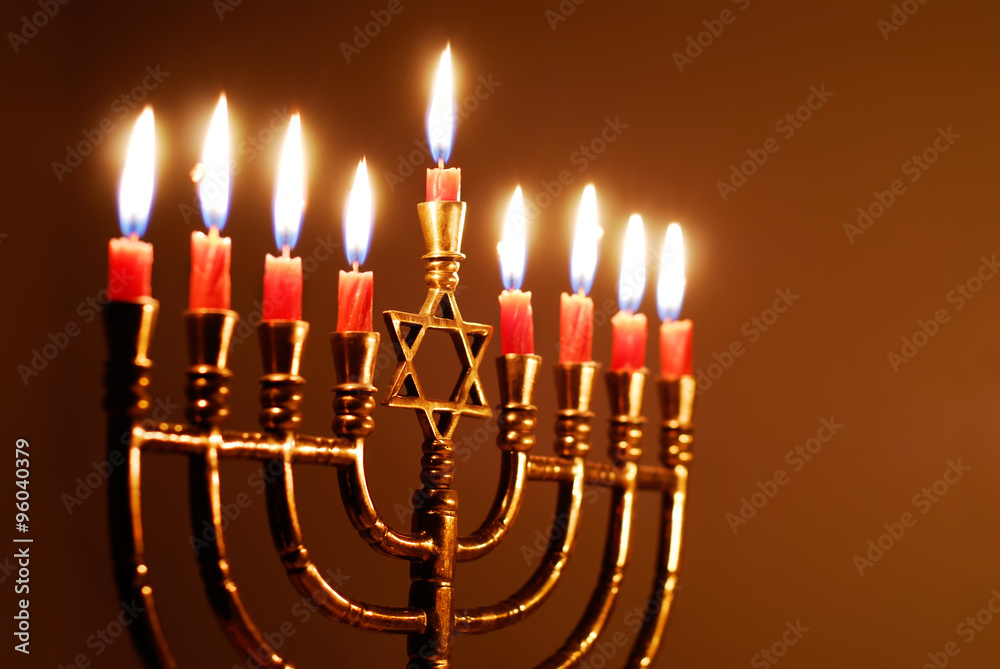
The Babylonian Talmud (written A.D. 450-550) records an event know as the Miracle of the Oil. According to this text, when attempting to rededicate the temple, Judah and the priests found there wasn’t enough oil to light the lamp for more than a single day. And per the Torah, it had to burn continuously. And they didn’t have time to get more oil. But they lit the lamp anyway in faith and it burned for eight days until they got more oil. That’s a miracle indeed. And from this the Jews get the meaning behind the tradition of lighting the eight-candle Menorah. Though it’s worth noting that the practice of lighting the eight-candle Menorah existed for much of the time since the events of 167-164 B.C.
But did it happen?
People debate whether this particular miracle happened. The Maccabee books leave it out as does Josephus – who recorded the Maccabean revolt in a similar way as the Maccabee books. However, we don’t have any earlier written sources for the miracle of the oil then the Talmud. There is evidence that the lighting of the eight-candle Menorah existed for centuries, but the Jews associated the eight candles with the number of days of Hanukkah in general rather than the specific eight-day miracle.
So did it happen? I don’t know. What the Talmud records likely started as an oral story that finally got recorded. Does that mean it didn’t happen? No. Does that mean it did happen? No. Like I said, I don’t know for sure and I don’t think anyone can know for sure at this time. Not unless we start finding earlier written accounts of it. That would make it much more likely.
But regardless of whether it happened or not, it’s a part of the story and origin of Hanukkah and that makes it worth repeating here. In addition, God’s nature certainly makes this miracle likely. According to the Bible, God fights for His namesake. He fought for His temple more than once, and honored the prayers of faith of different people in the Bible when God never actually told them He would do what they prayed for. But He honored those prayers because He loves His people and He loves it when they offer up bold prayers in faith. Joshua praying for the sun to stand still is a good Biblical example of this. Another is Jonathan’s faith that the Lord would help him and his armor bearer defeat a bunch of Philistines.
Hanukkah in the New Testament
At the beginning I mentioned that the New Testament records Jesus observing Hanukkah. Where is that found? John 10 records the one instance of Hanukkah in the entire Bible.
Then came the Festival of Dedication at Jerusalem. It was winter, and Jesus was in the temple courts walking in Solomon’s Colonnade.
John 10:22 (NIV)
Hanukkah is derived from a Jewish word meaning “dedication”. And thus, Hanukkah is also known as the Feast of Dedication. So what does this mean knowing that Jesus celebrated Hanukkah? Simply put, Jesus approved the creation of the holiday to commemorate and celebrate the victory and rededication of the temple to God. I see it as a type of validation by the Son of God.
It also means that Jesus had fun and enjoyed the different festivals. Sometimes I think we see Jesus as way too serious and not having any kind of fun. But Jesus celebrated all the different holidays. We know about Hanukkah from John 10, Sukkot from John 7, and all the gospels mention that He observed Passover. Often the Jewish holidays had a solemn part to it, but they all contained a lot of elements of celebration – joyous, loud celebration with music and feasting.
So there you go. Jesus knew how to have fun.
Wrapping Up
And there you have it. Hanukkah in a nutshell. Pretty incredible story. Even if the miracle of the oil didn’t happen, the Maccabean Revolt is miraculous enough to warrant such a holiday. Personally, I believe that the miracle of the oil did happen. I just don’t have the evidence to back it up. But that’s okay.
And with that, I declare my series on Jewish holidays finished. And to be honest, I’m not entirely sure what I’m going to write on next. We’ll see what God lays on my heart. But if any of you have suggestions, please let me know! Leave a comment, send me an email at corylewis@tillingandplanting.com, or use the contact form. Sometimes God speaks through other people so your ideas might be exactly what I need to hear to know what He wants me to write about.
Outro
If you enjoyed this post, please consider doing one or all of these things. First, subscribe if you haven’t. If you have, thank you! Second, spread the word. Send these to everyone you know and encourage them to read and subscribe. This blog is purely word of mouth right now. I rely on you, my readers, to help me get more readers. And third, please consider donating. It’ll enable me to continue to offer regular posts.
Feel free to leave a comment with any questions about what I’ve written, any additional comments about the post, or if there’s a topic you’d like me to write about. Before doing that though, be sure to check out all my posts here and see if I’ve covered it already. And if you find I’ve done it already but aren’t satisfied or still have more questions, let me know! You can also contact me through this form.
Thank you for reading this! I greatly appreciate each one of you. Until next time, God bless you all!

Leave a Reply